Showing posts with label Visual Culture. Show all posts

Thursday, 8 January 2015

FSA


The FSA; meaning Farm Security Administration, was organisation created during the Great Depression in the United Sates by the government. It was used to take action against the poverty in rural parts of America that had been hit hard by the economic disaster and where it has been mostly effected.The administration aimed to improve the way farmers who were affected were living and allowed the FSA to purchase parts of their land. It also gave an option to rehabilitate them into group farms if necessary so that it could be more financially manageable to live. They also provided loans to the farmers to that they could afford to keep working on their own farm and have enough money to be able to live and support their families. The FSA created a photography programme that illuminated the rural areas and has proved to be highly influential and produced iconic pieces of work. Only eleven photographers were apart of this programme, who worked on portrayed how the Great Depression had ruined the lives of the people they captured. From the beginning of the FSA, its photography has been included in hundreds of books and magazines. In the 1930's in would go along side stories that would explain the problems that they were trying to put across through these images and aim to make people realise the effect the Great depression had. Each of the eleven photographers had a different focus for what they were going to capture and the people they were going to present, it showed the people who lived in the city what it was like to not have a lot of money living in these desperate conditions, for example Dorothea Lange's work who has since became very iconic in the photography world. Her most successful image "Migrant Mother" taken in 1936, was one of the most used out of the thousands of images the FSA produced. The expression the women holds in the image, straight away shows the conditions and emotions that came with this event, presenting how bad life was for these individuals. The FSA was very relevant at this time as it brought attention to people like "Migrant Mother" which were then exposed to the public. It has been a hugely important association in history for the uses of documentary photography and influence of photographers over time, showing the importance of documenting and capturing life. 


"Migrant Mother"
http://www.moma.org/learn/moma_learning/dorothea-lange-migrant-mother-nipomo-california-1936

Artist, Designer, Author

Art has an emotional and spiritual impact on people, whether it is by its creator or spectators. The debate of artists being authors is a debate that has been widely researched. Steven McCarthy, Graphic Designer, wrote a book "The Designer as Author" which explores the role of designers/artists that have to take on different aspects for their projects. The point of being a designers shows that we have an obligation to address problems that come with it, so therefore have to explain and narrate these factors. Films and books that are produced are meaningful in the way that they communicate to show life as it is and why it is worth living. Designers and authors use this when presenting their work whatever it may be, to communicate and highlight the importance of it and the value it holds to its creator. Events have been recorded over history that show we can communicate with others, such as cave paintings many thousands of years ago, that highlights how we can be connected through what we create. Communication is also important in the sense we need other people to gain ideas and inspiration, to then go on to construct and organise our next project. For example Van Gogh had a creative partner who was also a painter who would often work with and around each other, feeding ideas off one another. Other artists and designers use apprentices, who would learn off them, then creating more projects that have been inspired from themselves. Jeff Coones is a very successful and well known artist, known for his reproduction of sculptures and objects. Jeff works with around 120 people who also create his sculptures, and without them they would not be produced and Jeff would not result in having any work. This is an argument of the designer using other people and not themselves to create their art and would not themselves become the author. The debate of when is art art and when is design design for when it relates to each other is is also often brought up for when it counts as author. This occurs because every piece of design, art and photography whatever form it maybe becomes itself at a certain point. Although it does not have a certain moment, it often depends on the opinion of others for the determination for what it truly is.

Wednesday, 7 January 2015

The Photographic Message

The photographic message is an issue that has been debated since the creation of photography. Each image holds a meaning and insight into what the photographer has thought when taking the image and what they have wanted to put across through the photography. Roland Barthes created a theory that applies a system in which we can denote and connote images. Denoted means how the photograph is portrayed and literally comes across. Connoting is the references and symbolic meanings that is in the message of the photograph. Depending on what the image is for, depends on the message behind it. Such as if the photograph is for advertising the message would be to benefit what is being advertised whether it is for a holiday or something for the audience to purchase. The message also depends on our knowledge as an individual and will see different messages to other people because photography has so many different meaning's, we translate them in our own unique way. Text also has an important role in the photographic message because when we see images in a newspaper or next to a story, it instantly changes our opinion depending on what it says. If we just look at a photograph we then will decide what we think it means, but if we then read something about what is happening or what the image is about it then will change what we think. This is important because it is then the text that illustrates the photograph rather than the image being the the only crucial element. Barthes goes on to explain how it is also important how close the text is to the image because it is the structure that also determines the connotations in the image. Below I have included examples of the photographic message. It is a self portrait by Nan Goldin, and straight away is clear that it is a woman who has been beat up, the denotation. The connotation then is that the woman may have been in an abusive relationship or she has been in an accident.
The realism in photographs is also a debate in the photographic message. This includes that idea that realism is the signifier in the actually photograph and that we only see the subject matter for what is is. Semiotics is also included in this, in how it signifies between what we seen straight away and what the concept of it is, interpreting the image as a collection of signs that are there to be read .The photographic message theory by Roland Barthes proves to be useful when analysing photographs and shows us that a photograph is more than what it just appears.

Nan Goldin

Documentary photographer, Nan Goldin started her photography career during her teenage years. Her work has always heavily focused on the people who surrounded and were involved in her life. Her lifestyle is shown to be a subculture of living in the transsexual communities of Boston and New York, presented in her images of this glamorous way of living but also holds elements of the darker side of violence and drugs. In the documentary "I'll be your mirror" by filmmaker Edmund Coulthard,  it shows Goldin explaining her life that is captured through her images of the people who are and once close to her. The document of her life and events of times in her life is what makes the images so candid and interesting, which holds the connection of emotion that is apparent of what Nan had with these subjects in the photographs. The images hold a narrative of the certain experiences her and her friends had. During the documentary, it shows how much trust the subjects had with Nan because they were a family, which even though she is not in the images the feeling that it is her life and that she has a relationship with these people is still there. The experiences of violences and AID's in Nan's life is definitely apparent in her image because of the dramatic sense and honesty it shows. She also explains in the film how her work just happens and is never planned "I've never believed in a decisive portrait of someone" she states, which is what makes her work so successful in how she has captured these people in their worst and best moments, that has nothing to hide. The way Nan Goldin's lifestyle and career has been joined together presents a journey that is so personal has made her one of the most well known and successful photographers of this day because of the connection between her subject's and herself. They are moments in time that are frozen but show the life within it that is full of emotion that has featured throughout her lives work and have became physical memories. The images that I have included below are what I feel are relevant to what I have mentioned above. They show exactly what her life include, with the environment that is shown to the emotion on her subject matters faces. It is what has made Nan Goldin so iconic because her photographs are full of truth. There is nothing to hide in these images, you can feel the stories within them which makes you want to know more.


Monday, 15 December 2014

Gender and Otherness

What we perceive as normal and ordinary is a question of everyday life that has been a popular subject for over the last 70 years or so. The terms 'Otherness' and 'Gaze' are the way we look at things and people, which determine our opinions and how we see them. Otherness is how we see the differences between one group and another showing how one is superior to the other one. The Gaze is   how an individual person or group's appearance is presented and how they look is set into our opinions. Their are many stereotypes surrounding these issues such as the Male Gaze that shows a group of assumptions that seep into our mind because of the media. The Male Gaze includes the cowboy, war hero, romantic and in most cases that fill our cinema, television and books is just a general hero. In all these platforms around 80% of the time the protagonist is a male and presents a gaze to how the character is shown. For females this does not happen as much, but appears in more softer versions such as romance films ect. The female gaze was challenged in the second world war through propaganda posters such as the Rosie the Riveter poster that shows a woman working hard to keep the country going whilst the men where at war. This was then challenged again by the male gaze after the end of the war that convinced women that their essential role in life was to be a mother and a housewife. It was not only cinema and the media that expressed this but fashion and arts such as photography. Clothes shown in the 1950's and 60's present how they were designed to cover up the female body and highlight their practicality rather than usefulness. However on the other hand women were and still are represented as sexual objects to the male gaze, it is represented through porn, cinema ect. The female Gaze presents men this way also, which were not as common in the 60s as it is today. Overall 'Otherness' and 'Gaze' is exploited through media and the commercial world. Photography has been a way of doing this as presenting the interests of the world depending on the opinions of what is normal. The dominance of women over the past 70 years is shown through photography and how the Male Gaze over powered females. It has shaped our opinions over the years  to how we see things and decide how we perceive them.

The image as Documentary

Documentary photography is supposed to present a fact of time and record the truth, which does not lie. However the way we see and decodes things leads to the questioning of photographs, that are meant to be documentary. Roland Barthes, french theorist created an analysis called 'The Photographic Message'. Barthes explained that there is two levels of meaning when looking at images, which are Denoting the image for what we can see in front of us and connoting the image for what we can see is telling us that is also purposely put there. Press photography is generally believable from first glance because it is placed next to information that is presented on the television news and newspapers, that we believe is truthful. Newspapers such as The Guardian and The Times display how press photography can be perceived. The Guardian is the type of newspaper to put across more political and left wing opinions of events that are happening around the world, however there is a danger than when we see an image, it is seen from just one point of view, rather than denoting it and looking deeply into the other meanings. Barthe's argument is further extended to how the meaning of a documentary image is produces. The artist e.g the photographer selects what they do and do not want in the image and has a certain attitude towards the events they want in the image. This straight away creates the first opinion of the documentary photograph. The next step is the text that goes along side the image, which automatically can change the thoughts when read next to something depending on what it is about. Finally the viewers opinion on the image is how successful the story is and if it is going to be believed. Documentary photographers such as Steve McCurry and James Nachtway show how their work can be perceived when next to text. Below is one of Nachtway's images for TIME magazine, showing how the image can be one thing but when it is presented with text it shows a whole other layer to the story.
Overall it seems that for ever how long press photography has been used to record an event or object, the meaning depends on how the photographer captures and feels about what is selected for the image and how the viewer also see's it.

Tuesday, 9 December 2014

Portrait and Photography

Portraits initially define the subject but also what the photographers intention of what the image means and speaks out to its audience and if it creates a reaction. Portrait's originate from centuries ago and has been a symbolic use of showing identity and power ever since. They were extremely popular during the 16th century and famous painter of this period, Han's Holbein reflects how portraits were an important part of everyday life, which now presents history and development of this subject. The painting "The Ambassadors" painting in 1533 and by Holbein is one of his most famous pieces of work. It contains two men of power, which is known through the colours used and the way they are dressed. The painting has many objects that has created debate over the years because of the religious status of that period. Holbein also included an anamorphosis, a distorted skull on an angle at the bottom of the painting, this will of had a symbolic meaning when it was produced, which again has been much debated. Another famous portrait painting by Gainsborough "Mr and Mrs Andrews" presents a view of power because of the land and body language of the subjects and also the fact Gainsborough has included their land, that shows the couple are very self assured of themselves and their lives. As photography has developed it is clear to see that the painting's I have mentioned have had influence in a number of portrait photographs, keeping some of the themes seen in paintings centuries ago. American photographer Tina Barney reflects this is her work such as her portrait "New York Couple" that also presents wealth and shows the identity of the subjects. Not only has portrait paintings and photography presented wealth, power and identity, but how it shows us history. Photography was and is an amazing invention that has allowed to see how people lived from the late 1800's. Edward Curtis' work is a great example of this because he documented the American West and its native people who also lived there, which was interesting at the time because the people Curtis was photographing were also the ones that fighting and killing them, but is great because he has documented this people that we do not hear of anymore. Sociology also has an impact on portrait photography because of the issues that surround society. Photographers over the decades have captured an objective way of seeing which can can be confrontational in the issues that are going on or have been around the world, that presents the subject of what photographers should and should not photograph. Portrait's also create a passage of time and embraces the sitter in photographs that is clear depending on what clothes are worn, furniture surrounding the subject or when comparing two images together that maybe of the same people, but within that moment of the photograph it is gone, which Roland Barthes explained in his theory of photography a "mini death" because it is gone in seconds. When presenting their portrait work, photographers generally always have a context behind it, which they want its audience to see and deconstruct, that photographys such as William Eggleston and Cindy Sherman present, but depending on our beliefs it may come across differently. Eggleston creates a prejudice in his images because of the narrative that he creates, which makes the audience question the background of the image and what is going on. Sherman however uses everyday situations in her portraits of herself that makes the audience shocked and question todays society.
Portrait photography has filled the world with history and identity that makes us question the world and want to know more about the person in the photograph's that show us different situations and circumstances effect us and our lives.

Tuesday, 11 November 2014

Tourism, Landscape and Myth

The Myths of Tourism
The imagery of tourism is seen to create realities of places through how it can occur to look positive and somewhere that appeals to the eye. The actual place that is being advertised is often not shown in what the actual reality of the place is but is shown to how stereotypes of tourist area's are supposed to look like, that are featured in travel brochures and postcards. We as people are attracted to are's that we have never been before because of the images that are used on tourism consumption, as we expect to see these countries and area's to look exactly how they appear and forget about any negativity that could come with it. Stereotypes of tourism is what we see has places of interest and landmarks in countries and cities that we want visit from seeing our friend's photographs and also reviews that we can read about these places, such as the Eiffel Tower, Berlin Wall and the Colosseum. Photographer Martin Parr has produced a number of pieces or work that show tourism in different ways. He breaks down tourist attractions by concentrating on what surrounds them rather than the actual object that tourists are interested in. Advertisement places a huge role in tourism as they only show us what they want us to, to make us want to visit. Travel brochures are a key example to this as they only show the reader selected images that highlight the best parts. Photography's role in tourism is how photographs can create a safeness as the photographer can choose what is in the image and in this case of tourism, is assigned to capture the right things that will make the audience feel safe. Although it all seems very positive, sometimes tourism can objectify the exotic other that is presented through photographs because it will often include images of the people who live in the tourist area, working and making their living. It is offensive as the tourist obviously has time on their hands and has money to be able to visit places because they appear to be looking down on them.


Martin Parr - Small World (Book)

The landscape has also been seen as a myth over time. Artists often included landscapes in paintings of people because they wanted it to view themselves as having land which meant they were wealthy. However in the 18th Century painters would also produce images of people who were peasants in their homes, that would appear more positive that what their lives actually were such as 'Cottage Door' By Gainsborough, the image included warm colours and the husband providing firewood making it seem normal. The landscape appeared to be a place where people could live and work safe and be happy. Photography also show's how landscape can be a myth, John Kippin's work is shown to be ironic in ways because of its link with the past. His piece 'Shakespeare Country' shows this because of how different the landscape is in a lot of places compared to what images of the more positive part of an area is. We often forgot that everywhere has a bad part to it, rather than what we are just shown.

Above all Tourism and Landscape is seen as a Myth in many different way. The art of painting and photography presents a view, that can fool its audience to believing, what the image appears like in front of us. This can often cause problems with our expectations and what we think the place in the image is actually going to be like, because of what is chosen to be in its framing. They often miss out the negativity, but photographers such as Martin Parr and John Kippin have produced work that contrasts the views we are expected to have in the stereotypes that are given to us.


The Art of Landscape

The Image as Space: The Art of Landscape
Photographs appear and are considered on a number of levels. The physical level of a photograph means that it is an object, which is usually in print form, rather than just on a computer screen. The print holds an image that the photographer has taken, which is argued to be an insight into the place and objects of where the photograph was taken, like a window. The physical level is where we devise what is in the image and what it appears to mean. This level also means the plain flatness of the print, contributed from the flatness of the camera. Colour photographs and prints also as another level of descriptive information to the image because it is how we as people see things and they have an effect on what we believe, such as when the photograph was taken could appear to look like something totally different. Photographs can be kept as a record and saved for years to come, be bought and produced as a visual work of art, showing how the audience ties different approaches to how an individual see's the context. Another level of images is the Depictive level. This level means what is in the images analytical context. The photographer decide's where we look and what to select when taking an image, what equipment is used and what settings to produce what the image will end up like. Our senses can not be used on a photograph because it is a deception of space, the only attributes which can define a photograph is the flatness, timing, focus and framing. These characteristics define how the image looks. Framing separates what you want in the images, making it different because you decide what is in it as the edges show what in, rather than what is not. There is two types of framing, that are passive and active. Passive framing means that there is not a lot going on and focus's on fewer objects rather than a lot. Active is when there is a lot of things have been including and more is happening and objects have been clearly cut out. Our attention span of different objects also effects how we see images and how their meaning appear's, depending on what we find most interesting and what stick's out, which makes photography good at provoking feeling's.
Landscape photography has an intelligent effect on people because it is not questioned on what is real in the image. One of the most famous landscape photographers and it still well know today, Ansel Adams ones said "Not everybody trusts painting's but people believe photographs". This shows how easy it is to have an effect on people's emotions and how photographs can be so significant not only in landscape photography, but in all genre's. But landscape photography presents how beautiful the natural world is, such as in Ansel Adam's work in the Yosemite National park. There are many other landscape photographers in the world that also present the power of nature, such as John Blackmore who tend's to spend a lot of time in the area's he takes photographs and is more about the idea's that come with that place. William Christenberry works with landscapes that surrounded him in his childhood, making it appear to be about memories. Photography with the same concept as Christenberry's help us learn about cultures and where the images are taken. William Eggleston also can be seen as using this idea in his work, because it put's across feelings that are quite sentimental and what seem like familiar places.
Overall the use of Landscape photography can be an escape from reality for its audience because f its beauty and power. We as individuals are drawn to this type of photography because of feelings it can trigger inside of us and how we can deeply analyse images of places that make us want to know more about or even visit. 


Ansel Adams - Image from http://www.archives.gov/research/ansel-adams/


William Eggleston - Image from book 'William Eggleston Guide'

Sunday, 19 October 2014

Photography in the 1960s

Photography in the 1960's presented the rock and roll lifestyle that many of the youth culture of this period were living. With thriving photographers such as David Bailey and Brian Duffy, the 60's has been captured and is has a very noticeable style that is simple but was completely different to what any other photographs had done before that time. The documentary film 'The Blow Up' presents famous photographers, models, film makers and artists of the 1960's and shows they worked and what work they produced. It is interesting to see the difference in photography in that era to the work of todays. There was no digital cameras or computers to edit photographs on, it was all done by film and then printed in the darkroom. David Bailey is no doubt the most recognised photographer of the 1960's because he photographed famous and everyone who was anyone at that time. The photography in the 60's also brought a new look to fashion, famous models such as Twiggy, presented this in magazines like vogue. Photography showed new and up coming trends on models that the audience would want to copy off and look like. Overall this era developed photography that still has influence today and has inspired many photographers from the 60's that is still relevant today. 
 
Some of Bailey famous portraits: 


Images From:  http://www.npg.org.uk/collections/search/person/mp05044/david-bailey?role=art

The British New Wave and Realism

The idea of realism is to have a sense of perception and knowledge and to be able to hear, see, feel, smell and taste. We as people have to rely on a reality being meditated for us such as the news, magazines, newspapers and the radio that feeds us information that we tend to believe. But the problem here is fidelity of representation and the thought of can we believe these sources of media. From the 1930's to the 1950's Britain these representations being challenged by its public because of the start of americanisation, that had the influence of Hollywood, that initially saw traditional home values go down the drain because the younger generation were getting an idea of a glamorous individual lifestyle that was shown through film. Anxieties of the Cold War were also always a problem, but the fact of new space technology and knowledge meant that satellites were now in space, which the public tended to question the government and their policies that made them think were they spying on you because of these giant electronic devices in space. The film industry noticed these problems and started to reflect them in new movies such as, 'The Blue Lamp' and 'Victim', that were both directed by Basil Dearden in the the 1950s and 1960s. These films were classed as kitchen sink films because they presented the domestic situations that the working class people of Britain could relate to. The British New Wave movement also the punk movement rise up, because these youths wanted to challenge anything and everything, which was seen as the angry new man image as they were expected to behave like their parents but instead went again them. As the youth culture started to get their own jobs outside of school and college, they began to have a disposable income that meant they had spare money to spend on their own music and clothes. In the 1950's women were seen to be wanted back in the kitchen and housewives were a common sight in a normal household. This created social problems that gave new ideas to the New Wave British cinema and addressed things that hollywood film did not such as, underage sex, adultery, homo-sexualtity, abortion and mixed race relationships, programmes like 'Saturday Night and Sunday Morning' and 'A Taste of Honey' addressed these enough. This meant that you could make something of yourself whatever class you were in. Overall the British New Wave saw a sense of realism like no other decade before, the 1950's and 1960's addressed issues that were common occurrences and situations that were real life. The film industry did not tip toe around these issues but presented them how they were happening in everyday life.

Tuesday, 14 October 2014

Jeff Wall and Tom Hunter

The City of the 21st Century
Jeff Wall and Tom Hunter are both very successful and well known photographers of the 21st Century. Both their individual work combines the elements of Fine Art work and they both recreate famous painting's and build stories that present a modern feel, that previously captures society in the 19th and 20th Century, as they both have an interest in the reproduction of reality through these art works. Jeff wall's work is hybrid, his work is staged but is not clear unless known or really thought about, which are called straight documentary. First glance at his work and it would look like a documentary style photography but at the same time is apparent to look staged if analysed. It is clear to see that he is influenced by contemporary films and fine art such as his photograph "Mimic" taken in 1982. Personally the first time I seen it I thought it was real, but after researching and talking about his work I began to see how staged it was but represented real life situations, this piece is focused on racial gestures and how it relates to people and how it is an issue. Even though this photography is staged, it circulates the problems of real life, which the audience can understand straight away. Tom Hunter also has a similar style to Wall. Hunter's aim in his photography is to capture modern life but are influenced and are reproductions of famous paintings. When compared next to each other, his work is very similar but completely different in the sense that he has made it completely his own work that no one has done before, that appears to draw you in but is also a little bit awkward. Overall both photographers, Jeff Wall and Tom Hunter have amazing raw work that explore modern life but are a take on painting from the last hundred or so years. Their work is extraordinary and different to other photographers because of their staging and similarity of art and how it is still relevant to todays societies.

Jeff Wall - Mimic


Tom Hunter - Ye Old Axe
Reproduction of Diego Valasquez shown below.


The Golden Age of Illustration 1880-1920

The Golden Age of Illustration is seen to of lasted from 1880 to the 1920s, but from the start of civilisation people have used it to show how they lived their daily life and beliefs in religion and have always considered it an art form, however there was no such job or being that would be classed as an illustrator. Such as in the Medieval period in the 1500's people sketched simple illustration's that showed biblical stories and events which happened, for instance the burning of protestants at the stake during Mary I's reign. Also the Egyptians illustrated massively, even on everyday items like vases. The 19th century saw more publications become further available due to new printing technologies that were being invented. Artists then were commissioned a lot more due to the printing companies that were expanding, so that they could create more narratives to stories that were a lot more visual, but being an illustrator was still not classed as being a proper profession still at this time.  Up until the 1920's, this period of time saw a lot of new publications and new technology allowed a lot more cheap products in which the illustrations were published and a mass production of how many books or newspapers would be formed because of the high demand the market was at this time. One of the reasons that provoked the high demand in the Golden Age was the attractions with the Medieval period of the 1500's. It presented more of a gothic appearance to the covers of books and more sinter stories. It also saw artists such as William Morris,  who had an eye for beautiful patterns and hand printing. Morris created the Kelmscott Press company in 1890, that showed his admiration of illustration and how it could associated with the text and its meaning. Another factor of the importance of the Golden Age was the Aesthetic Movement, that presented the appearance to be beautiful, so that it matched it narrative. Walter Crane was one of the Aesthetic Movements most celebrated illustrators of this time, which showed more of an interest in the surroundings rather than just a character or main subject, that have the audience a guide of what their homes should and could look like. It also presented a style called romanticism that was seen suitable for the middle class and was more of a style for children's books. Famous Golden Age children's book writer, Kate Greenaway used the romanticism style in her books that gave off a feel and perfect image what children should look and act like such as in one of her most popular books Under The Window. The illustration of children's books by women introduced a role women could be in the creative arts in society of this time that also saw the importance of language and literacy that supported the artists. By the 1920's illustration was finally seen as a trading business and industries would focus on it as a real profession. It developed into a much more modern style that saw fashionable women living their glamorous lives, which represented a higher society. This also influenced the production of fashion, that saw the beginning of Vogue magazine and other fashion bibles. However this was quickly short lived and the new popular art form, Photography, soon took over with fashion shoots instead by the 1930's. Overall the Golden Age of Illustration saw the creation of new technology that help production in printing and a more visual narrative that supported its text making it much more interesting and helped it move away from illustrations that were there to explain something that was in print form. New art was established that explored previous centuries and future generations that meant different possibilities were available and was enjoyed as a creative skill that was adaptable in the printing industry whatever its media may be.


William Morris - Taken from http://www.wmgallery.org.uk


Kate Greenaway - Taken from http://lynnechapman.blogspot.co.uk/2010/07/shadowing-greenaway.html

Monday, 13 October 2014

Picturing the Modern City

Artists and Photographers have expressed the appearance of modernity in cities and urban area’s for many years. The term modernity means the quality and moving forward of an object or environment. Factors such as the industrial works, science and communication all have helped in the production and are still important in how the modern city expands and grows. Paris in the nineteenth century is seen as one of the main cities that first appeared to becoming modern. Architect, Baron Hausmann was seen to of rebuilt the main city centre in Paris. It gained new places of leisure for the middle-class to enjoy, whilst the poor were forced to the suburbs of the city. This was certainly enjoyed by impressionist painters who then became part of the leisured middle-classes, because the changes in the city that contributed to new subject matters. Art became even more popular, which showed new ways of looking at things, that also came from photography. The underclass became a attractive subject matter for artists and photographers because of their interesting experiences, which was the other side to upheaval of the city,  who had to cope with new modernisation that negatively effected their lives, that the artists generally became concerned. It was photography that presented this adverse side of the city, to create awareness to those who did not realise there was such poverty, to try and make it a more suitable place for social reform. Photographers such as Jacob Riis, captured similar situations to this in cities like New York. He presented many different back alley's and interesting characters in everyday situations, to show this to the other classes that had no idea what went on with the people that were considered below them. The start of the twentieth century saw the turn of vision into a modern technological place of the future. All art forms became more geometric and abstract, creating a difference and huge growth to the modernity of what the previous century was before. Cinema was a new art that showed this expansion in how technology was the future, by presenting films that showed the city as a place of destruction and ill morals, which photography and art have continued to also do and even to this day cities all over the world have changed and so has our perception because of the media and art forms that change our attitudes and opinions.


Sunday, 12 October 2014

Material Culture as National Identity: Tokyo Youth Culture

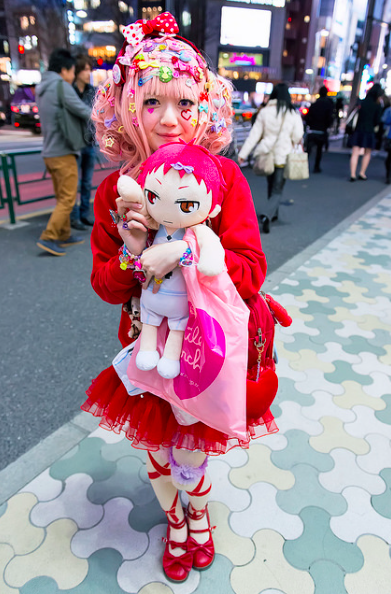
Japanese Youth Culture is very unique and has became very popular since its rise in the 1980's. No where else in the world has any youth culture like this and in Japan it is considered to be whats called 'Angura' which means it is its own culture. Within this extraordinary country, rather than just one type of  culture, it has many different groups that are called tribes, that are based on certain type's of looks. Many copy and look like popular subjects such as anime and musical inclination. The images below show how the Japanese youths dress very bright, colourful and is clearly very experimental. The main aim in most cases, is to be 'Kawaii' meaning cute and the distinct rejection to grow up and become more mature is the way teenagers in Japan are that has remained a key element in how they look. The beloved Kawaii trend has not just been apart of fashion, but because of the obsession with it, now is seen on products like handbags, household objects, cars and even planes, which is also apparent across the world with brands such as Hello Kitty being hugely popular in almost every country. There are many subcultures that are all very different but most still carry cuteness. Groups such as Decora, Lolita, Kawai, Ganguro, Visual Kei, Cosplay and Shironri each have their own different style and would be clear to see when in Japan and some being more gothic than others. If you are in a Japanese Youth Culture, the place to be seen in Harajuku, which is known as an international centre for the subcultures and other fashion interests. It is a huge community for shopping and eating. The main area to be for the youth culture is Yoyogi Park, where you can see other people with similar dress sense and those who are different. It commonly observes Harajuku fashion walks, which can be considered a competition to show off what you are wearing. Another popular area within the Youth Cultures is Akihabara or known as 'Electric Town' because of it being a main shopping town for electronic items, but is a popular place for video games and anime. Anime and Manga have created cosplay in Japan, which is when youth cultures dress up as their favourite characters in these animations. Music stars also copy their look off these comics and cartoons so their image will jump out at their audience. The music is not the only most important factor in their careers, but appearance is the next main influence, that can often be confusing for an outsider, because gender is not always clear to see. Ambiguity is not relevant in Japan because the beauty of these young men overstep's any reason for why they should not show it off, which hair and makeup does, that creates a presence and 'look' that will be remembered by their audience. Overall Japanese youth culture is massively popular and over the years has gradually became more common in Western countries, that can be scene even in the music business with artists like Katy Perry and Marilyn Manson, which shows the freedom in dress sense has made the world interested and amazed by these youth cultures.


Image's taken from: https://www.flickr.com/photos/tokyofashion/