Showing posts with label Still Life. Show all posts

Tuesday, 12 May 2015

Evaluation

During the course of the still life module, I have gained and developed my skills, knowledge and experience when producing work within this area of photography. Throughout this module I have completed five mini-assignments, containing a brief including an area of still life photography and also a brief written by myself creating an individual learning agreement, that focused on one of the given areas to photograph. The past 12 weeks has expanded my knowledge on still life and shown me that it has a much wider range of areas that can photographed and still be classed as still life. The area’s I have produced research for and photographed were food photography, product photography, Vanitas and Nature morte inspired photography, documentary still life and Digital Montage.  Each one of these area’s of still life photography were very new to me, but through seminars, techniqual workshops and producing images I quickly adapted and developed an understanding of each area.

The decision to continue on to Level 6 to produce fine art or commercial photography was definitely apparent in this module to help and guide us, through the different area’s of still life photography. With food and product photography being included in the commercial side and documentary, digital montage, vanitas and nature morte being fine art photography, it has been a great insight and experience to continue from other modules and learn what other genre’s of photography have to offer and help continue into what area to focus on next year. Each one of these types of still life whether fine art or commercial, has shown me what different skills are required depending on what is being photographed and what environment it is in. Such as the commercial side very much being photographed in a studio based environment with the use of capture one and Photoshop, and the fine art side also shot with the use of the studio, but can also be produced by photographing on location.

From learning and producing work that represents each area of still life has lead me to become even more of an individual learner and helped me realise which area of photography I am most interested and skilled. Having lectures, tutorials, workshops in the studio and working with a group have all assisted with my development in still life photography, but also photography as a whole. The structure of the module also contributed to this. As each area of still life photography that I researched and then created during shoots only lasted for two weeks, it was a great way to having to produce work and images to show on a schedule in a short time. It was motivating to want to research the still life types of photography and then shooting very much straight away and having group critiques the following week to gain feedback on our work. It was helpful to have feedback from other students and tutors, so that whatever was said could be acted against in future shoots.

The individual learning agreement was a productive and insightful way to progress on to what area of still life photography I could preform my best. Choosing Documentary still life photography was a decision I made to focus on because I felt my interest towards that area was a lot stronger than any of the others. My skills were a lot stronger when performing and producing images that represented documentary still life. I had a lot more idea and overall enjoyed doing this part of the module the most.

 I plan to continue onto Level 6 with the purpose to produce fine art photography. I am more drawn to this area rather than commercial, because I prefer working on location and in day light rather than in the studio. I hope to continue working in the studio and progressing my skills, which can be used in fine art photography that can further my work and ideas even more. My ideal specialism in fine art photography would be documentary. Personally I think that the stories that can be told through this type of photography are much stronger than any other, which is what makes me so interested in it and producing still life documentary work, has taught me knew ways of what and how I can photograph.


Overall this module has taught me many things and has introduced me to different genres of photography that I have never produced, or thought about photographing before. Food and product photography introduced me to the more commercial side of still life, that has taught me new skill and techniques when working in a studio environment, such as the lighting and ways to use the software capture one to gain the best results, and also how to style products so they look great on camera whether it is a product or food. The three other still life genre’s that were completed in the fine art scheme of things also showed me a lot about still life photography. Before this module I would never of though that documentary or digital montage could be called still life, but now after producing and creating images to represent them, I can now see why.

This module has been a success and enjoyment to complete from start to finish, due to the diverse range of areas within still life photography, and how each one has had something to offer in terms of the different skills needed and how they can be used, which will benefit a photography career in any field. If I were to do anything different during this module it would definitely be to shoot more. If I did this, I would have developed even further in still life photographer and would of produced better results. Another downside to this project was my final prints. I sent my images to be printed from a company called DSColour labs. They did not come back how I expected them too, which was not very good. They are all darker than the actual images are and the resolution is not good either, I would definitely choose a different method of printing next time as I did not have the time to send them off to be printed again anywhere else. Furthermore, I think I have gained and achieved many different skills and developed in photography to a higher level. The module has taught me to become a more individual learner and also to become more comfortable working in a team. I have enjoyed this module thoroughly and will definitely continue to develop my skills in still life photography.


Final Prints

Below are my final five prints from each mini-assignment from the full module and the three images as a result of my ILA that I will hand in on friday 15th of May. I have listed them in the order of which assignment came first and then followed on to the others.

Food.


Product.


Vanitas/Nature Morte.


Documentary.


Digital Montage. 


ILA.


Change of Plan.

After analysing my final shoot more thoroughly, I have came to the conclusion that I am going to use four different images for my ILA. I have decided to use a different image of a different purse/wallet instead of the same one. This is because I think that they look better as a series when placed next to each other when they are of different objects. Each image is then more individual and tells a different story, and appears more interesting. Although the three I have previously chosen do connect together and have a narrative, they did not flow as well as the ones I am now definitely using. My final images as a result of the ILA are presented below. I am really drawn to this idea of documentary still life and will continue shooting purses/wallets, so that i will end up with a larger series. I am happy with these images and have successfully achieved my learning agreement, in that I have produced a series of images that represent personal and sentimental objects.

Final three images as a result of my ILA.


Final images as a result of ILA.

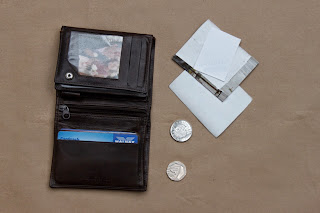
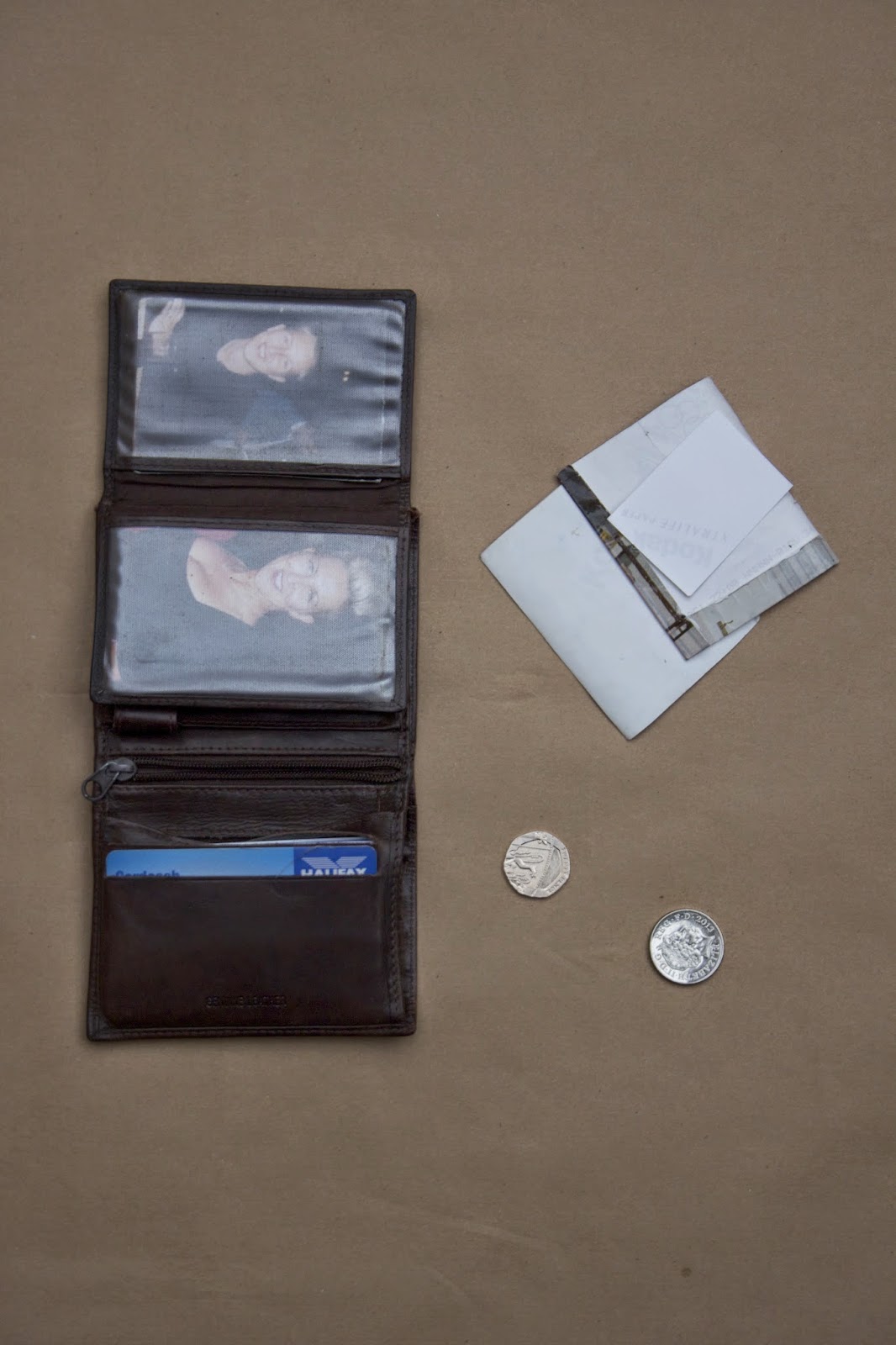
After my three shoots I have completed for my ILA I have decided that my last shoot, of the insides of wallets and purses are going to be my final images to send off to have printed to hand in as a result of my agreement. I found myself to be more successful in this shoot and was a continuation from the previous shoot in the mini assignment of documentary still life a few weeks back. I have chose three out of the whole shoot to hand in as I think the three images I will hand it, represent my ILA the most. My intention was to produce a series of images that were presented sentimental and personal objects. I have still achieved this but instead of photographing individual objects belonging to an individual, I have photographed their purses and wallets and whatever is contained inside them because it can say a lot about a person and often includes personal objects because people carry their wallets with them at all times and so the sentimental object would be with them at all times as well, as a reminder of what it means to them.


3

For my final shoot I decided to focus on purses and wallets, as I did in the documentary still life mini assignment. Whilst shooting I found myself once again drawn to this narrative and objects as I shot them before. I find it a very interesting concept, seeing and photographing the objects in peoples purses and wallets as it can say a lot about a persons personality and interests. I have shot 3 different purses and wallets that belong to people that I know. I have used a plain background so that nothing can distract the viewer from the objects. Each container is unique and different, bring something individual to each image so that they are connected, but don't look the same. For these images I have included a title rather than a piece of text because I think the objects speak for themselves. I think these images have worked out more successful than my other shoots for my learning agreement because of my images being similar to previous shoots in the module. My plan now is to decide which images I am going to use for my final prints, on which images are most suited and connected to my learning agreement and the story I want to tell through them to the viewer.

Contact sheet. 

Favorites from the shoot. 


2

For my first shoot I decided to shoot objects that I own myself. I shot two objects that have a close and personal reason to me and I thought it would be an interesting contrast to include my own objects compared to other peoples. Again I have included a piece of text with the image so that it is clear why I have taken a photograph of the object as I think the image would appear lost and the viewer may become confused. This shoot has worked better than the last, because I think I have created a style within this project for my learning agreement and is more apparent in this shoot, because of the more pictures I have taken. I have also included black and white edits of the images as well as colour, the same as the last shoot because I want to have a choice when I come to choose my final images and am yet to decide which I prefer. I think these images work well with my meaning and story behind them, especially with the text. I have cropped the objects into a square frame as I think it focuses on the object a lot more and so there is not a lot of space around the object that is not needed.


This is the only object that was my Grandad's that
 I own. I never met him, but from these rosary beads
 and from what I already know about him, religion
was a big part of his life. So having these is something
meaningful to keep and know it was important to him.


This rabbit is something I will always keep. My Gran
bought it for me when I was staying with her when
she lived in London when I was about 8 year's old. I 
have so many lovely memories of staying with her
when it was the school holidays, and this reminds me 
of them. 

Tuesday, 28 April 2015

ILA - Documentary Still Life

For this part of the module, I am to write an individual learning agreement stating which area of still life photography I am going to focus on for the remaining four weeks until hand in. I have chose to follow this field of photography for this part of the module because I feel I am most confident in all of the types of still life photography I have studied and practiced during the course of each mini-assignment, such as food, product, vanitas and nature morte and digital montage photography. Documentary photography is a genre I personally would like to continue doing into Level 6, and feel it would be the most suitable to practice for my individual learning agreement. I plan to shoot two or three times a week so that I will have a good choice of images to choose from for my final prints for when it is hand in. Documentary still life has fascinated me more than the other area's of still life photography because of how it presents a narrative.

The narrative that my photographs will present are going to include objects that hold a sentimental value to them, similar to what I produced for the documentary still life mini assignment. I am going to approach family, friends, colleagues and peers to present me with an object that they own that has a nostalgic, fondness or sentimental value to them and photograph it. Along side the photographs I will also present a set of text that explains why this has a special meaning to the individual. I am yet to decide whether the text will be a description written by myself, or what the individual who's object it is has spoke about it and present it as a piece of text or some sort of audio. I am going to shoot on location rather than the studio, because I think this can effect the final outcome of how the story of the image is portrayed and how it will appear.

Over the course of the next few weeks I will update my blogger with where I have been shooting and what I have been shooting, which will develop how I plan to decide what images will be best to use for my final series.

Wednesday, 15 April 2015

Digital Montage Shoot

For my digital Montage 'shoot' I have collected a range of images that I feel go well together and represent still life photography. All the images have been taken from google as for digital montage it does not really matter where the images are from, it is more about what you create with them. Below are the images that I have cut out using the quick selection tool to cut out the object that I need to place on to my digital montage. I simple have used a brick wall as the main background and placed two palm trees on to it. some coconuts and a cartoon sun. iI used all of these objects because I think that photographed individually, they can all be accepted into the still life genre. So placing them all together still makes it still life, but placing them all together makes it a digital montage. As this is my first digital montage I have kept it very easy and simple, whilst I learn more about photoshop and how to use it.


My second digital montage I have expanded further in my skills and researched more photographers in the digital montage field. I have decided to use different sunglasses from the branch Coach that is based in America. It is a designer brand that produces bags also. I have created this digital montage by using different layers for each pair of sunglasses and also included the brand name underneath, as if it is a advertising campaign. I have also created this in the style of David Parfitt who is a product photographer. Although he is a product photographer I have created my image in the way digital montage would be, in photoshop and maybe David Parfitt has as well. 


I would definitely like to explore digital montage photography even further as anything can be included or made in to a digital montage. The possibilities are basically endless. It can be objects placed together or even a mood board type image. Digital Montage has expanded my skills in photoshop, which I will definitely be improving also. 

Tuesday, 14 April 2015

Digital Montage Photographers

David Brandon Geeting


David Brandon Geeting is a well established photographer in many different fields. The three images above are just a tiny insight into his huge selection of work on his website and tumblr. I enjoyed looking through his tumblr the most and have become really fond of his work because of how different his work is, nothing like I have seen before. A lot of his work includes different objects and background that appear to have been created on photoshop or any other retouching softwares. I particularly like the second image I have included. The objects look to have been placed there that are from different images, showing how it is digital montage photography. He seems to specialise in this area photography but includes it in his fashion and editorial work. Digital montage really compliments his work because of the bold colours he uses that makes the object he is focused on photographing really stand out.

Mari Mahr


Mari Mahr's work is quite a contrast to the other two photographers I have presented here. All of her photography shown on her portfolio on her website is black and white, rather than the other photographers I have researched, where it seems to be bright and colourful. Her digital montage work seems to be one large photograph in the background then other photographs on top of that and then maybe even more physical objects over that. I like the way Mahr has created her work through using  a number of layers to create the digital montage effect. It seems that she has not used photoshop to create this, although it would be possible by using that also. Using black and white rather than colour works for her photography, as it appears quite dark and emotional.

Qui Yang


Qui Yang's work has been featured in numerous fashion magazines and websites. He presents his own style throughout all work in his portfolio, that has clearly led to his successful with major companies such as Elle magazine. Much of his work is fashion or editorial photography, but includes digital montage techniques, which is what makes his photography so unique. Bold and colourful seems to be  a recurring theme throughout his work, which always seem to compliment the objects he is photographing, whether it be jewellery or clothing. His work is definitely edited on photoshop, or another software as it is clear to see the different shapes and objects he uses along side the products have been manipulated with.

Monday, 13 April 2015

Digital Montage

Digital Montage photography is totally different to any other still life based photography that I have studied and practiced for this module. Digital Montage requires the use of photoshop to create images that may include more than one photograph placed on top of one another either physically or through photoshop. For example it could be created with a background image and then other images can be included by being cut out whatever shape or object they may be. Digital Montage is in the field of still life photography because it is often just one or a few objects with not a lot going on around them. The photograph can often be of anything, including fashion magazines. I have included a few examples of what I think is digital montage photography. The images are all focused on one object but the objects around it have been manipulated or been 'cut out' on photoshop and have been placed there, making it a digital montage. For my own Digital Montage I am going to focus on layering on photoshop and include around five or more images, placed on top of each other to give a montage effect. I don't really have a certain idea in mind, I am just going to use images that I think are still life and will show still life in the aspect of Digital Montage.


Tuesday, 24 March 2015

Group Crit and Reflection

In our group crit on friday(20.03.15) each group presented their work on the magnetic board in the studio. We then proceeded to talk about each others work, about the positives and what could be improved on each image. Everyone's work represented Vanitas or Nature Morte and had symbolism within the objects that were used, just light paintings in the 15th century such as Treck. The feedback for mine, Lauren's, Sophie's and Jess' image was very strong because of the way we placed the flowers, which seemed to be very popular with its audience. No one else had done anything like this so it stood out from the others to be quite different, and once everyone knew the meaning behind it, it was clear to see why we arranged it the way we did. A way we could improve that was mentioned was the lighting and if any of us were to to it again we should change the lighting as it was too harsh, as to how the light source was in the paintings.We also did not follow this mini-assignment, to recreate the painting using modern objects, which would be interesting to do if it was done again.  It was great to see other work from the different groups to see how Vanitas and Nature morte was presented, through how people understand the meaning behind it.


Nature Morte and Vanitas shoot

For our mini assignment for this part of the module, Still Life: Nature Morte and Vanitas, we were to recreate a painting from the 16th or 17th century, when this genre was very popular, presenting the subject with modern materials and objects. We were assigned to groups to discuss the painting given and how we were going for recreate it. In the same group as myself there was, Katie, Lauren, Jess and Sophie. We then decided on how and what we were going to do and gave ourselves a certain object we would then use in the shoot. All of us decided it would be best to shoot the following day (13.03.15), and to shoot using the Phase One camera as it would overall give us the best results with our images. It taken us around half an hour to set up, which we used the boom to attach and arrange the flowers on using masking tape, so that they were upside down. The decision to use the flowers upside down was a completely last minute idea, that we all agreed on as it was an interesting and different way to present them, rather than on the painting, were they are just in a basket properly upright.


Once we had completed arranging the flowers, we places other objects underneath them on a table with a black cloth over the top. We used objects that were similar to the ones that are in the painting such as the fruit, which we slightly changed by using apples and strawberries rather than pomegranates and peaches, due to the thought they are a more popular fruit of today's society. Shell's were also used, like they were in the painting. The use of dead roses was also an important element, a few were arranged around the bunch of flowers and then a gathering of the leaves below it, so make it appear they had fallen. In the painting the objects are arranged on two levels, unfortunately we did not have anything that was like this, only a wooden frame shown in the image below. 


In all of the paintings that we had previously were shown in a seminar of Nature Morte and Vanitas examples, the light source always comes from the left hand side. We placed an Elinchrom light, on the left sides slightly in the middle so that it would light up and create shadows similar to how it is in the painting. After taking a few shots and placing the light slightly different we were then happy with where it was. After a few attempts the whole arrangement and idea of the objects did not seem right and with input from Ant and Tim, who though there was too much going on in the image and was not really working. We then decided to go for a totally different appearance and idea, and taken all of the unnecessary objects out of the picture. In some of the images taken, it emerged to us that it was much more successful without the shells, wooden frame and fruit, but with a couple of the dead roses added to the wooden board with the fallen leaves. 

The meaning of our piece had slightly changed throughout our time planning the previous day and during the shoot. However we knew that it would be questioned as to why the flowers are upside down, rather than on the original painting they are displayed in a normal way. They are that way because it represent life following in to death, the fresh flowers then looking down on to dying flowers that are then followed by the dead roses that have then fell, which is portrayed as death.

A couple of complications occurred when shoot which was that he dead rose bud's were very dark and there was a few problems in lighting a couple of them on the right side. We then added the board with a gold reflector over, which worked successfully in making the rose head's lighter. This finished off our lighting and equipment that was used and was then on the road to producing our final image to use. Other problems that cropped up was the arrangement of flowers and how it had to be altered a few times to create the display we wanted, as at first there was a lot of greenery  and stalk but not enough flowers, I think that this was due to fact not a lot of planning had gone into this which would of been more appropriate. 


Overall I feel that our shoot worked very well and were successful in recreating our given painting. We worked well planning and shooting in the studio together and all having our own input into the final result. Although it does not look similar to the painting due to the flowers placed upside down and the lack of modern objects that were supposed to be used, it represents still life Nature Morte correctly in the way we have been learned. I would definitely like to continue shooting this style of still life and would plan this shoot again so that it could be improved and more successful.

Final image.


Nature Morte and Vanitas influenced Photographers

During our seminar with Jill speaking about Nature Morte and Vanitas, we were also shown still life photographers who had influences of Nature Morte and Vanitas in their work. Each photographer's work still includes the stillness that is shown in still life paintings, and consists of objects that represent and have an important meaning. The work of the following photographers have clearly been influenced by past paintings and still have elements that were important in past art work, when still life was very symbolic to everyday life. Modern photographers have made their still life work more influential to todays society and what is relevant to their own lives and others around them.

Marian Drew
Marian is one of Australia's most powerful and significant contemporary and still life artists of today. Her Still Life project "Australiana" from 2003 to 2009 presents images of dead Australian bush animals, that she had found already dead, placed next to objects that are somehow linked together. Her images from this series were all really interesting to look at because of the animals and how Marian had placed them. It is clear to see how these photographs are influenced by past vanities and nature morte painting because of the style and the way everything is placed. The different element Drew has used that is not the same as other still life vanitas styled photography and paintings, is that she has a background in some of the images from this series that is not white or black, it appears to be another photograph or an actual environment that she has used behind the objects she is photographing. I think this works with these images because of the narrative behind it being about her home country of Australia and the use of animals that are from there.


Lorenzo Vitturi
Lorenzo Vitturi's series of work "Dalston Anatomy" presents a book full of colourful images of people and surroundings of east London's Ridley Road market. He focused on this because it was local and special to him, but also starting to change due to gentrification. It was important to Lorenzo to capture this area before it transformed completely. The photographs from this series are seriously different to anything I personally have seen before. They are so individual in the use of colour and use of objects and people, it really does represent this area of London he is photographing. The still lifes that are included in this series are a mixture of fruit, vegetables and objects from the market and all placed and sculpted in a way that is connected to what Lorenzo is representing. In an interview with magazine Of the Afternoon, Vitturi explains that he arranges these sculptures because he ttys to find anatomical similarities between the objects and the people that he photographs because they show how everything about this market is connected and because the sculptures only last a couple of hours representing how these markets and people he come's across only last for a certain time too.